
Learn More. Feel Better. Live Healthier.
Committed to Helping You Navigate True Health
In an environment of public dissatisfaction in health care we strive to be an advocate of information for doctors and patients. Subscribe for free information about alternatives for your health condition.

Connecting Unique Healthcare Information with Common Sense
Scientific health discoveries can take decades to appear clinically. Let's here to bridge the gap.

Physical Health
Suppressed solutions for pain and physical dysfunction are discussed here.

Biochemical Health
Chronic disease has become an epidemic, making prevention paramount. Discover new avenues of healthcare diagnostics and functional resolutions

Mental Health
Solutions for mental health can be found here.

Connecting you with doctors that can help
There are multiple offices that may be able guide to the right solution for your health condition.
Helping find doctors that consider root cause
Minimally invasive methods that help
Discover the best options
Connecting the Right Patient to the Right Approach
The average person who wants to feel better and live healthier would like to do it in a way that requires less need for surgeries, medication dependency, shots and invasive technologies that can cause harm to our health. When there are physicians who focus on more efficiency, safety, less invasiveness and more healing technologies. We help bring them to the forefront.


Connecting Health Problems to Real Solutions
As patients are struggling and not finding answers we hear the call and we're here to help.
60%
Of adult Americans have at least one chronic disease
This includes diabetes,
cancer, and cardiovascular disease, autoimmunity, thyroid disease
50 million
50 million adults in the United States experience chronic pain
Every year there's an increase in the number of chronic pain cases.
500,000+
Medications are the third leading cause of death
Nunc porttitor, diam ut euismod commodo, urna augue


Committed to Helping You Get Healthy
Lorem ipsum dolor sit amet, consectetur adipiscing elit. In convallis turpis efficitur enim efficitur pulvinar.

Deeper Insights
Nunc porttitor, diam ut euismod commodo, urna augue dictum lectus in consectetur purus.

Putting it together for you
Nunc porttitor, diam ut euismod commodo, urna augue dictum lectus in consectetur purus.
Committed to Helping Your Health Improve
Getting the right information at the right time is crucial for timely results. Too many are unable to get connected to the right health information and options that match their needs. We are here to introduce new and effective health ideas and connect you to the right sources.

J. Wheeler

I've opened my eyes to new options

B. Jackson
I would have never known about the best healing options had I not been introduced.
Read Our Latest Blogs
Lorem ipsum dolor sit amet, consectetur adipiscing elit.
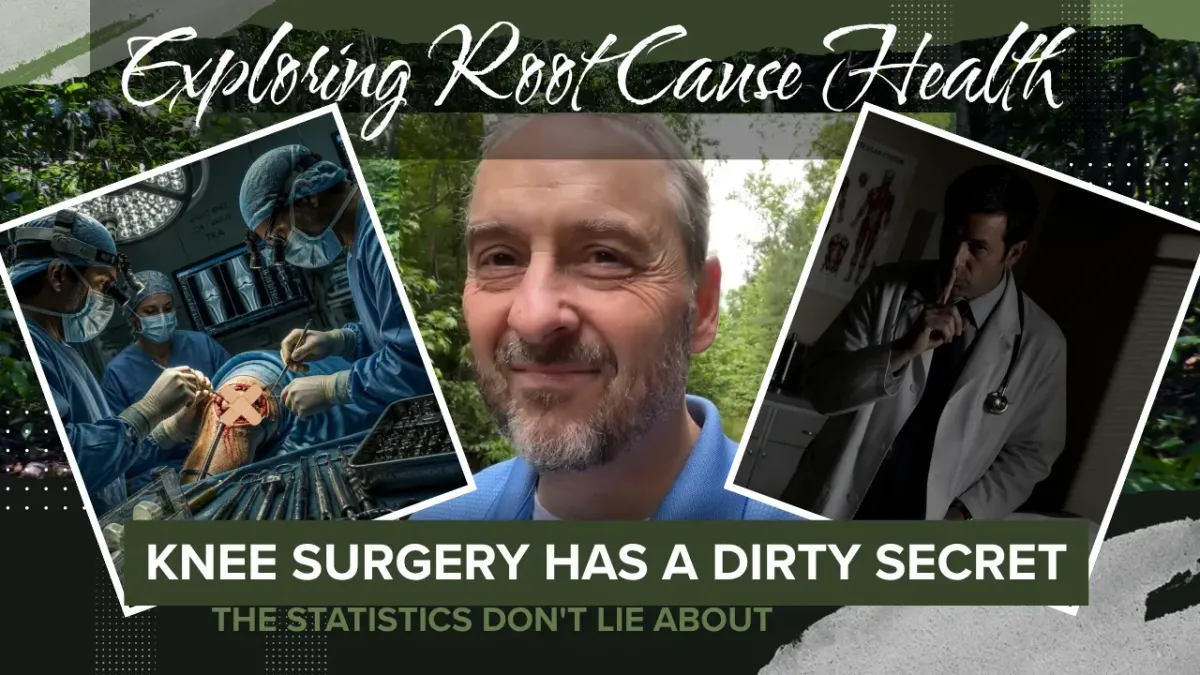
Knee Surgery Has a Dirty Secret the Statistics Don't Lie About
Knee Surgery Has a Dirty Secret the Statistics Don't Lie About
[00:00:00]
You've been dealing with knee pain for a while now, maybe months, maybe years. You've tried the injections, you've done the physical therapy, you've taken the anti-inflammatories, and one day your doctor looks at your MRI, your X-ray, and he turns to you and says, "You know, I think it's time we talk about surgery."
And something interesting happens. Something interesting at that moment, despite everything you've been through, despite all the treatment that didn't work, that sentence carries, carries a kind of weight, a finality, a seriousness that makes it feel like the real answer. This is the thing that's actually going to fix it.
I understand that feeling, and [00:01:00] I want to have an honest conversation with you about it. Because the statistics, the actual published research on the most common knee surgeries tell a story that patients are never shown before they sign the consent form, and I think you deserve to see it. There's something deeply embedded in the way we think about surgery that makes it feel categorically different from other treatments.
Pills feel temporary. Injections feel like a, like a Band-Aid. Physical therapy feels like homework. But surgery, surgery feels definitive. It feels like someone is actually going in, seeing the problem, and physically correcting it. There's something viscerally satisfying about that idea. And surgeons are among the most skilled, the most trained professionals in medicine, and I wanna be clear about that.
This conversation is not about surgeon competence, not at all. But here's the [00:02:00] question that rarely gets asked before a surgical recommendation: Is the problem in this knee a structural problem that surgery can correct, or is it a biological problem that surgery cannot address? Because those are two fundamentally different situations, and conflating them, treating a biological problem with a structural solution, is where the system breaks down and where patients end up exactly where they started, sometimes worse, wondering what went wrong.
The research has actually been trying to tell us this for years. The problem is, it doesn't always make it into the exam room conversation Let's talk about the numbers, and I want to approach this carefully because I'm not here to cherry-pick data just to make a point. I'm here to share what the body of research actually reflects and let you draw your own conclusions.
Let's [00:03:00] start with one of the most commonly performed knee surgeries in the world, arthroscopic surgery for knee pain, which often includes procedures like trimming or what's called partial meniscectomy, and a procedure called debridement, which is essentially cleaning out the joint. In the United States alone, hundreds of thousands of these procedures are performed every year, and for a long time, they were considered standard of care for knee pain and osteoarthritis.
Then the research started asking harder questions. One of the most significant studies in this space was published in the New England Journal of Medicine. Researchers took patients with knee pain and osteoarthritis and divided them into two groups. One group got the real arthroscopic surgery, and the other group got what's called a sham surgery, meaning they were taken into a, an operating room, anesthetized, small incisions were made in the [00:04:00] knee, and then nothing else was done.
They were sewn up and sent home believing they'd had the real procedure The result? Well, both groups improved equally. The patients who had the real surgery did no better than the patients who had nothing done to their knee at all, except believe that something had been done. That study was not a small outlier.
It's been replicated. And it's fundamentally challenging the premise that arthroscopic surgery is correcting something in the knee that produces measurable, meaningful improvement. Now, let's talk about knee replacement, which is a much more significant procedure and one that does have legitimate outcomes in certain populations.
Knee replacement, when it works, can be genuinely life-changing, and I want to acknowledge that. But here's what the broader data shows. Studies have found that significant percentage of knee replacement patients, some [00:05:00] research suggests anywhere from twenty to as, as high as thirty-four percent, report that they are not satisfied with their outcome.
Persistent pain after knee replacement is well documented in the literature, and a condition called CPSP, chronic post-surgical pain, afflicts a meaningful subset of patients who undergo the procedure. Furthermore, knee replacements are not permanent. The majority have a functional lifespan of fifteen to twenty years, which means younger patients who receive them are very likely facing a revision surgery down the road.
And revision surgeries can carry significantly higher complication rates. Again, I'm not telling you knee replacement is never appropriate. I'm telling you that the picture painted in the surgeon's office is not more optimistic than the population-level data supports. And the question that should follow all of this is why?
Why do some people not get the outcome [00:06:00] they were promised? The answer to that question is the most important thing I'll say today. Surgery is at its core a structural intervention. It reshapes, removes, repairs, or replaces physical structures. And for the right problem, a torn ACL and an otherwise healthy knee, a traumatic injury, a structurally compromised joint in an older patient with limited alternatives, it can be exactly the right tool.
But here's the fundamental flaw when surgery is applied to a chronically degenerating knee. Surgery can change the structure. It cannot change the biological environment that destroyed the structure in the first place. Let me give you a bit of an analogy that I think makes this very clear Imagine your car's transmission starts failing.
The gears are grinding, the performance is degrading. It's getting worse over time. So you take it, [00:07:00] and the mechanic installs a brand-new transmission, top of the line, perfect condition. But what caused the original transmission to fail was a deeper engine problem, something that was creating excessive heat or improper fluid dynamics or mechanical stress that no transmission was designed to handle long term.
So you drive off the lot with your new transmission, and then six months later, it starts grinding again Was that a new transmission defective? No. Was the mechanic incompetent? No. The problem is that nobody fixed the underlying condition that destroyed the original one. That is precisely what happens in a knee that has been degenerating due to biological causes.
Poor circulation to the cartilage, a chronic inflammatory environment, mechanical dysfunction, metabolic disruption, cellular breakdown that outpaces repair, and then receives a structural fix without addressing any of those underlying [00:08:00] conditions. The new structure, whether it's a trimmed meniscus or cleaned out joint or prosthetic replacement, now lives in the same biological environment that broke down the original.
The terrain hasn't changed, only the hardware has, and the terrain always wins. This is why people have knee replacements and still have pain. This is why people have arthroscopic surgery and find themselves back where they started within a year or two. It's not bad luck. It's not failure of the procedure in isolation.
It's an absence of an intervention on the biological conditions that drove the degeneration. Nobody went looking for the engine problem. They just replaced the transmission. Here's the conversation that almost never happens in a surgeon's office before knee surgery recommendations. What is the biological environment of the knee, and have we done everything we can to address it before we consider a structural intervention?[00:09:00]
What is the state of blood flow and tissue perfusion in the joint? What is driving the chronic inflammation, and has that driver been identified and addressed? What is the quality of the surrounding tissue, the tendons, the ligaments, the musculature, and what's influencing that? What is this person's metabolic health, and how is it impacting the knee's ability to repair itself?
These questions are not exotic. They're not outside the realm of evidence-based medicine. They simply require a different model of thinking. One that looks at the knee not as an isolated mechanical structure to be repaired, but as a living tissue embedded in a whole-body biological system. And here's what I find genuinely puzzling about the current landscape.
I would never send a patient for cardiac bypass surgery without first exhausting every possible intervention, the conditions that created the heart disease: diet, lifestyle, metabolic function, [00:10:00] inflammation, circulation. We would never recommend a liver transplant without first addressing the underlying disease process destroying the liver.
But with knees, somehow the conversation skips from this is degenerating to let's go in and fix the structure without a serious, thorough investigation of what is biologically driving the degeneration. That gap, that missing step, is where I believe a tremendous number of failed surgery outcomes are born.
And it's where the conversation needs to change. So let me be very direct about what I'm suggesting and what I'm not suggesting. I'm not telling you to never have surgery. There are knees that are so structurally compromised in patients for whom other options have been genuinely thoroughly exhausted where surgery is the appropriate path.
That is a real category and I'm- I respect it. What I am suggesting is this, [00:11:00] surgery should not be the default next step when conservative management hasn't worked because in most cases, the conservative management being offered isn't actually addressing the root cause either. You're not failing conservative care, you're failing a version of conservative care that is still symptom-focused, not cause-focused.
Before any surgical conversation, there are questions that deserve answers. Has anyone looked at why this knee keeps degenerating? Not just how much it has degenerated. Has anyone evaluated the biological environment of the joint and identified what's driving the breakdown? Has anyone attempted to shift that environment to support the tissue's own capacity to repair and regenerate before recommending that tissue be removed or replaced?
Because here's what I know from working with patients who have been told they need surgery, some of whom have been told they are bone on bone and [00:12:00] have no other options. The knee is living tissue, and living tissue, when given the right biological inputs and the right environment, responds. Not always completely, but far more than the conventional model gives it credit for.
The body built that knee once. Under the right conditions, it has more capacity to participate in its own restoration than most patients are ever told. That idea, the idea that we can work with the biology of the knee rather than simply bypassing it with hardware, is the foundation of a completely different approach to chronic knee care, and it starts with asking better questions.
Better questions than when do we schedule the surgery. So here's what I want you to walk away with today. Knee surgery, particularly the most commonly performed types, has an evidence base that is far more complicated than most patients are shown before making their decision. The sham surgery [00:13:00] studies alone should fundamentally change the way we talk about arthroscopic procedures for knee pain.
But beyond the statistics, the deeper issue is this: surgery addresses structure. It does not and cannot address the biological environment that created the structural problem in the first place. And until that environment is addressed, the structural fix is working against the current. That is the dirty secret.
Not that surgeons are dishonest, not that surgery never helps, but that the model driving the recommendation is often looking at the wrong level of the problem. In the next video, we're going to go even deeper. I'm gonna talk about what's actually happening inside a chronically painful knee at the tissue level, at the cellular level, and why the body's own repair system gets stuck in a cycle that it can't break out of on its own.
Because understanding that is what opens the door to a completely different kind of thinking about what [00:14:00] is possible for your knee. If this has landed for you, if this is a conversation you think someone you care about needs to hear, please share the video. These are the things people need to know before they make decisions they can- they really can't take back.
I'm Dr. Bob Millham at Wake Integrative Health, where we don't just manage the problem, we look for where it actually started.


© 2026 Doctors Health Hub - All Rights Reserved, This site is for informational services and not to be used for the diagnosis and treatment of disease.
This site is not part of the Facebook website or Facebook Inc. Additionally, this site is NOT endorsed by Facebook in any way. FACEBOOK is a trademark of FACEBOOK, Inc.


